
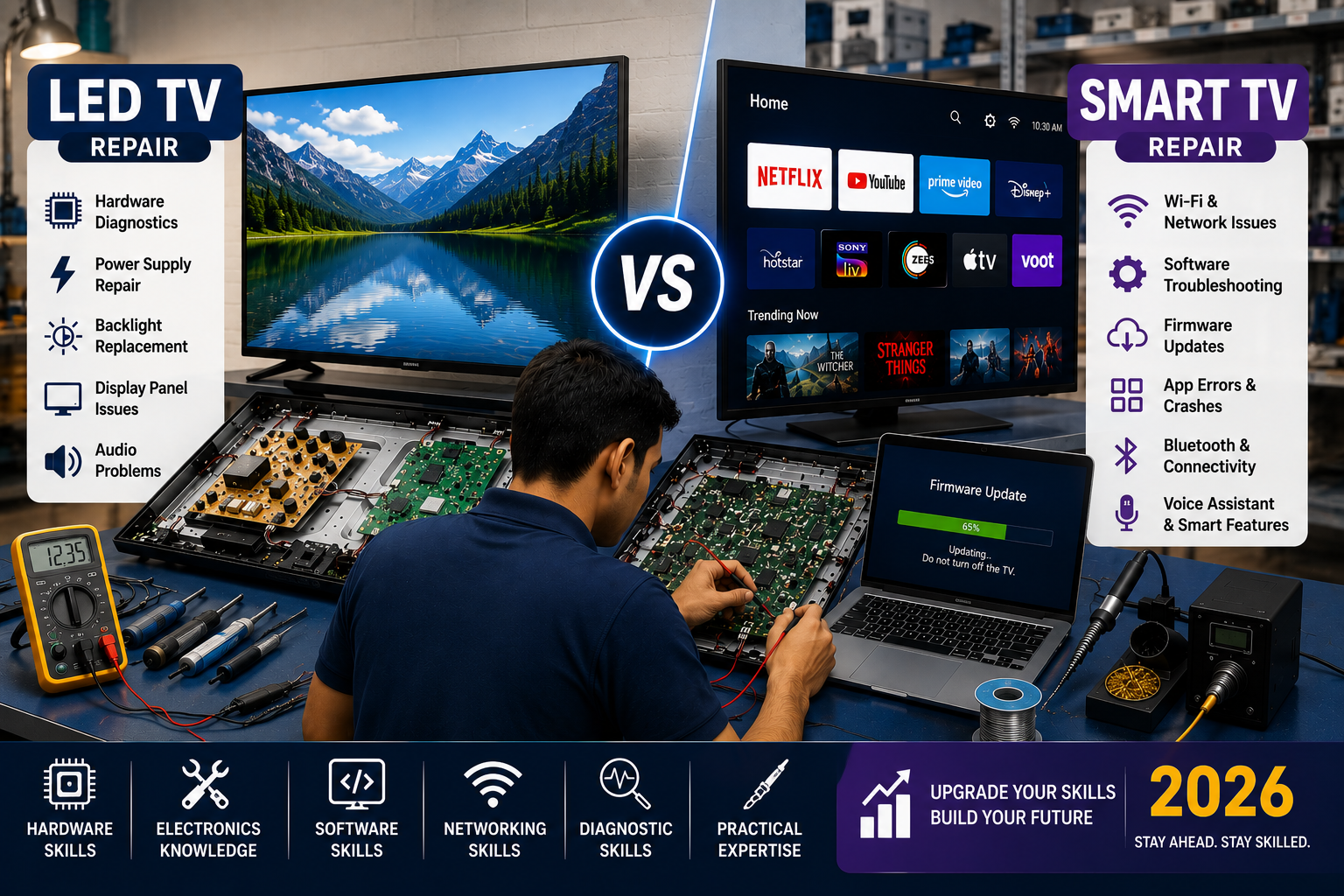
Television technology has evolved rapidly over the past decade. What was once a simple electronic device has transformed into an intelligent entertainment hub powered by operating systems, internet connectivity, AI-enhanced features, and cloud-based applications. As a result, the Smart TV Repair Skills required to repair modern televisions have also changed dramatically.
For aspiring technicians, understanding the difference between LED TV repair Training and Smart TV repair Training is no longer optional – it is essential. While both require a strong foundation in electronics, Smart TVs introduce software diagnostics, firmware management, networking, and operating system troubleshooting that traditional LED TVs simply do not require.
Whether you’re planning to build a career in electronics repair or upgrade your existing technical skills, knowing what to learn in 2026 can help you stay ahead in a rapidly evolving industry.
Understanding LED TVs
An LED TV is essentially an LCD television that uses Light Emitting Diodes (LEDs) as its backlight source. These televisions have been widely used for years because they offer better picture quality, energy efficiency, and slimmer designs than older LCD models.
Although LED TVs include advanced display technology, most repair work revolves around electronic hardware rather than software.
Common components include:
-
- Power Supply Board
-
- Main Board
-
- T-Con Board
-
- LED Backlight Strips
-
- Display Panel
-
- Speakers
-
- IR Sensor
-
- Input/Output Ports
Technicians repairing LED TVs primarily diagnose electrical faults, replace damaged components, and restore normal functionality.
What Is a Smart TV?
A Smart TV combines traditional television hardware with computing capabilities. It connects to the internet, runs applications, receives software updates, supports streaming services, and often integrates with voice assistants and smart home devices.
Popular Smart TV platforms include:
-
- Google TV
-
- Android TV
-
- Samsung Tizen OS
-
- LG webOS
-
- Fire TV OS
-
- Roku TV
Unlike conventional LED TVs, Smart TVs require technicians to understand both hardware and software systems.
LED TV vs Smart TV Repair: What’s the Difference?
Although the display technologies may appear similar, the repair process differs significantly.
| Feature | LED TV Repair | Smart TV Repair |
| Hardware Diagnostics | ✔ | ✔ |
| Software Troubleshooting | Limited | Extensive |
| Firmware Updates | Rare | Frequent |
| Wi-Fi Problems | No | Yes |
| Bluetooth Issues | No | Yes |
| App Errors | No | Yes |
| Operating System Issues | No | Yes |
| Streaming Service Problems | No | Yes |
| Motherboard Repair | ✔ | ✔ |
| Network Diagnostics | No | ✔ |
A technician trained only in traditional LED TV repair may struggle with Smart TV software failures, while a technician trained in Smart TV repair is generally equipped to handle both hardware and software-related issues.
Why Smart TV Repair Requires More Skills in 2026
Modern Smart TVs function much like computers. They run operating systems, process software updates, connect to wireless networks, and support cloud-based applications.
As televisions become more intelligent, technicians must expand beyond component-level repairs.
Today’s Smart TV technician should understand:
-
- Firmware installation and recovery
-
- Software corruption
-
- Boot loop diagnosis
-
- Factory reset procedures
-
- Wi-Fi troubleshooting
-
- Bluetooth connectivity
-
- Screen mirroring issues
-
- HDMI eARC functionality
-
- Streaming application errors
-
- AI-powered picture and sound features
These additional responsibilities make Smart TV repair a more comprehensive and valuable skill set.
Common LED TV Problems Every Technician Should Know
Traditional LED TVs continue to require skilled electronic troubleshooting.
Some of the most common faults include:
1. No Power
Often caused by damaged power supply circuits, blown fuses, or failed capacitors.
2. No Picture
The television powers on, but the display remains blank due to backlight or display circuit failures.
3. Vertical or Horizontal Lines
Usually caused by damaged display panels, loose ribbon cables, or T-Con board issues.
4. No Sound
May result from faulty speakers, amplifier circuits, or motherboard problems.
5. Backlight Failure
One of the most common repairs involving defective LED strips.
6. HDMI Port Damage
Physical connector damage or motherboard faults affecting signal input.
Understanding these issues provides technicians with a strong foundation before moving into Smart TV diagnostics.
Common Smart TV Problems in 2026
Smart TVs introduce an entirely new category of service requests.
Technicians frequently encounter:
-
- TV stuck on logo
-
- Operating system crashes
-
- Apps not opening
-
- Netflix or YouTube errors
-
- Wi-Fi connection failures
-
- Bluetooth pairing issues
-
- Slow performance
-
- Remote pairing failures
-
- Firmware corruption
-
- Failed software updates
-
- Voice assistant errors
-
- Screen mirroring problems
In many cases, these issues are not caused by defective electronic components but by software or configuration problems.
A technician who can quickly identify the root cause saves time for both the customer and the service center.
Essential Skills Every TV Repair Technician Must Learn in 2026
The television repair industry has evolved far beyond replacing faulty components. Today’s technicians are expected to understand both electronic hardware and software systems, making continuous learning essential for long-term success.
Whether you’re planning to work in a service center, start your own repair business, or specialize in Smart TV repairs, mastering the following skills will help you stay competitive.
1. Hardware Diagnostics
Every successful repair begins with accurate fault diagnosis. Technicians should be able to identify problems affecting the power supply, motherboard, display panel, T-Con board, LED backlight strips, speakers, and other internal components.
Strong diagnostic skills reduce repair time, improve customer satisfaction, and prevent unnecessary component replacements.
2. Chip-Level Repair
Replacing an entire circuit board is not always the best solution. Chip-level repair allows technicians to identify and replace faulty electronic components, making repairs more cost-effective for customers.
Skills include:
-
- SMD component replacement
-
- IC identification
-
- Micro soldering
-
- PCB trace repair
-
- Voltage testing
-
- Circuit analysis
Chip-level expertise also increases the range of repair services a technician can offer.
3. Firmware Installation and Recovery
Modern Smart TVs depend on software to function correctly. Firmware corruption can cause a television to freeze, restart repeatedly, or fail to boot.
Technicians should know how to:
-
- Install firmware updates
-
- Perform firmware recovery
-
- Use USB-based firmware installation
-
- Identify software corruption
-
- Restore factory firmware safely
4. Smart TV Software Troubleshooting
Many customer complaints involve software rather than hardware.
Examples include:
-
- Apps crashing
-
- Slow system performance
-
- Operating system errors
-
- Streaming issues
-
- Login problems
-
- Voice assistant malfunctions
Understanding Smart TV operating systems has become just as important as understanding electronic circuits.
5. Network and Connectivity Diagnostics
Since Smart TVs rely heavily on internet connectivity, technicians should understand:
-
- Wi-Fi troubleshooting
-
- Bluetooth pairing
-
- Screen casting
-
- HDMI eARC configuration
-
- Network settings
-
- Router compatibility
Many issues reported as “TV problems” are actually network-related.
6. Customer Communication and Service Skills
Technical knowledge alone is no longer enough. Successful technicians also know how to:
-
- Explain repair issues clearly
-
- Provide realistic repair timelines
-
- Recommend preventive maintenance
-
- Build customer trust
-
- Offer post-repair support
Excellent customer service often leads to repeat business and referrals.
Essential Tools Required for Modern TV Repair
Professional repairs require more than experience – they require the right tools. A well-equipped technician can diagnose faults more accurately and complete repairs efficiently.
Some of the most commonly used tools include:
-
- Digital Multimeter
-
- DC Power Supply
-
- Oscilloscope
-
- Hot Air Rework Station
-
- Soldering Station
-
- SMD Tweezers
-
- LED Backlight Tester
-
- USB Firmware Tools
-
- Screwdriver Set
-
- Magnifying Lamp or Microscope
-
- ESD Wrist Strap
-
- PCB Cleaning Kit
As technology advances, technicians should also become familiar with software diagnostic utilities and manufacturer-specific firmware tools.
Future Trends in TV Repair
The television industry continues to evolve rapidly. Technicians who stay updated with new technologies will have a significant advantage in the coming years.
Some key trends shaping the future include:
AI-Powered Smart TVs
Many televisions now use artificial intelligence to optimize picture quality, sound settings, and energy efficiency. Future technicians will increasingly troubleshoot AI-assisted features alongside traditional hardware and software issues.
Advanced Display Technologies
Manufacturers continue to introduce new display technologies, including:
-
- OLED
-
- QLED
-
- Mini LED
-
- Micro LED
-
- 8K Displays
Each technology has unique repair considerations that technicians must understand.
Smart Home Integration
Modern televisions are becoming central hubs for connected homes. They interact with smart speakers, lighting systems, security devices, and voice assistants.
Technicians should be comfortable diagnosing integration and connectivity issues across these ecosystems.
Remote Diagnostics
Manufacturers are increasingly enabling remote diagnostics through software, allowing technicians to identify certain issues before beginning physical repairs. Understanding these tools can improve efficiency and reduce service times.
Sustainability and the Right to Repair
Consumers are increasingly choosing to repair electronics rather than replace them. This shift supports sustainability, reduces electronic waste, and creates ongoing demand for skilled repair professionals.
Technicians who can perform reliable repairs contribute to extending the lifespan of valuable electronic devices while supporting environmentally responsible practices.
Why Smart TV Repair Is a High-Demand Career in 2026
The demand for Smart TV repair professionals continues to grow as households invest in larger, more advanced televisions.
Several factors contribute to this trend:
1. Growing Smart TV Adoption
Smart TVs have become the standard choice for homes, businesses, hotels, educational institutions, and commercial spaces.
2. Increasing Repair Complexity
Modern televisions combine hardware, software, networking, and AI-driven features. As complexity increases, so does the need for trained technicians who can diagnose and resolve a wider range of issues.
3. Expanding Career Opportunities
Skilled technicians may choose to:
-
- Work in authorized service centers
-
- Join independent repair shops
-
- Start their own repair business
-
- Provide doorstep repair services
-
- Specialize in premium television repairs
-
- Train future technicians
This flexibility makes TV repair an attractive career option for individuals interested in practical, hands-on technical work. Hence, there’s no doubt in the fact that, TV Repair training can boost your technical career.
Continuous Learning Opportunities
Television technology is constantly evolving, creating opportunities for technicians to expand their expertise and remain relevant throughout their careers. Read more on how Maximtronics prepares you for real-world TV Repair jobs.
Conclusion
LED TV repair Training remains an important foundation for anyone entering the electronics repair industry. However, the growing popularity of Smart TVs has transformed the profession.
Today’s technicians must be comfortable working with hardware, firmware, operating systems, wireless connectivity, and advanced diagnostics. Those who invest in developing these broader technical skills will be better prepared to meet industry demands and build rewarding careers.
Whether you are starting from scratch or looking to upgrade your existing knowledge, learning both LED TV and Smart TV repair provides a strong foundation for success in the evolving world of electronics repair.
If you’re considering professional TV Repair Training in Chennai, look for a program that combines theoretical knowledge with extensive hands-on practice on real devices. This practical experience helps build confidence, improve troubleshooting skills, and prepare technicians for real-world repair challenges.
Frequently Asked Questions (FAQs)
1. What is the difference between LED TV repair Training and Smart TV repair Training?
LED TV repair focuses primarily on hardware components such as power supplies, backlight systems, display panels, and motherboards. Smart TV repair includes these hardware repairs but also requires software troubleshooting, firmware updates, operating system diagnostics, and network configuration.
2. Is Smart TV repair training more difficult than LED TV repair training?
Yes. Smart TV repair generally requires additional knowledge of software, operating systems, internet connectivity, streaming applications, and firmware management, making it more comprehensive than traditional LED TV repair.
3. Can beginners choose Smart TV repair Training?
Yes. Beginners can learn Smart TV repair through structured training programs that start with electronics fundamentals and gradually introduce hardware diagnostics, chip-level repair, firmware installation, and software troubleshooting.
4. What skills should a TV repair technician learn in 2026?
Technicians should develop expertise in hardware diagnostics, chip-level repair, firmware recovery, Smart TV software troubleshooting, Wi-Fi and Bluetooth diagnostics, motherboard repair, and customer service.
5. Which Smart TV operating systems should technicians understand?
Modern technicians should be familiar with Google TV, Android TV, Samsung Tizen OS, LG webOS, Fire TV OS, and Roku TV, as each platform has unique software features and troubleshooting requirements.
6. Is Smart TV repair a good career in 2026?
Yes. The increasing adoption of Smart TVs, combined with their growing technical complexity, continues to create demand for skilled repair professionals in service centers, repair businesses, and independent service operations.
7. What tools are commonly used for Smart TV repair?
Common tools include a digital multimeter, hot air rework station, soldering station, LED backlight tester, oscilloscope, DC power supply, firmware installation tools, ESD protection equipment, and precision screwdrivers.
8. Can firmware issues cause a Smart TV to stop working?
Yes. Corrupted firmware can lead to boot loops, frozen screens, failed software updates, application crashes, and startup failures. Many of these issues can be resolved through proper firmware recovery procedures.
9. Do TV repair technicians need networking knowledge?
Yes. Since Smart TVs rely on Wi-Fi, Bluetooth, screen casting, and streaming services, technicians should understand basic networking concepts to diagnose connectivity-related issues.
10. Why should technicians learn both LED TV and Smart TV repair?
Learning both provides a broader skill set. LED TV repair builds a strong foundation in electronics, while Smart TV repair expands expertise into software, networking, and modern television technologies, increasing career opportunities and service capabilities.